By Philip Yatai
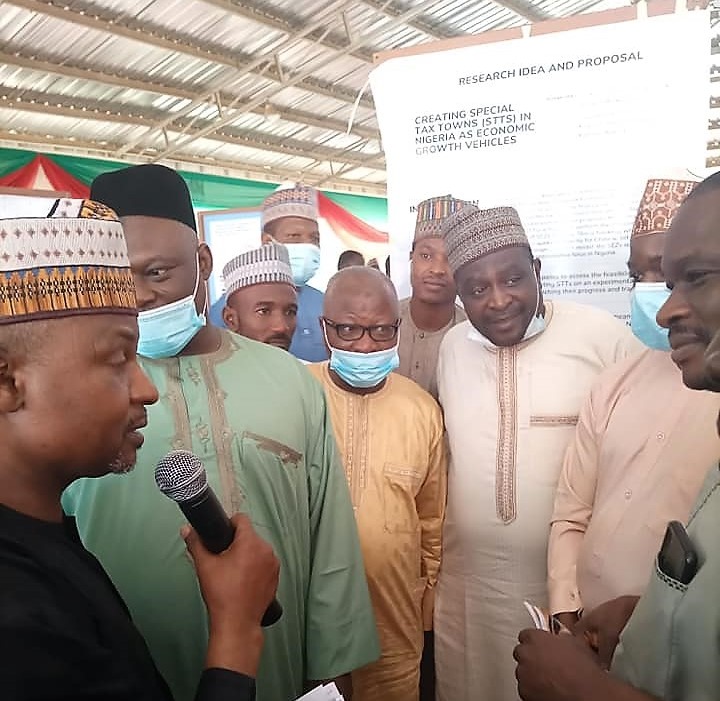
Prof. Terhemba Wuam, Department of History, Kaduna State University (KASU), has unveiled a research idea for the creation of Special Tax Towns (STTs) to drive the nation’s economic growth and development.
Wuam, a Professor of Economic History, made the suggestion in Kaduna on Wednesday at the University’s maiden research exhibition to promote research among academics and researchers.
He explained that the idea of the STTs was a policy of universal taxation of residents for the development of basic infrastructure and services in the towns.
He said that states could create the STTs on an experimental basis for a 10-year period, then watch and assess their progress and transformation.
“The special tax towns will be able to levy taxes for education, health, public infrastructure and other necessary social welfare and economic policies for the specific development of the taxed towns.
“The research will explore the outcome of the STTs strategy and harvest the energy and resources of the people through taxation and tax revenue to accelerate social and economic development in the towns.
“The findings will then inform the scaling up of the model to the entire country to propel national economic growth and development,” he said.
The don expressed optimism that the STTs has the potential of unlocking the resources and creative energies of the people towards their own mutual social and economic development.
He described the STTs approach as the “specific Nigerian response and solution” to the national problem of stagnated growth and oil dependency crisis.
According to him, China’s economic development in the last five decades is partly driven by the creation of Special Economic Zones (SEZs).
He said that the STTs idea intended to appraise how Nigeria could adapt the example of the SEZS to suit her national peculiarities and development aspirations.
“The proposed STTs in Nigeria will perform the transformative role similar to that of SEZS in China.
“This is because, although the SEZs works brilliantly for China to set the stage for its national economic growth model, the approach does not have the same transformative force in Nigeria.
“Thus Nigeria, in her development aspirations, can learn from the Chinese approach, by not copying directly what the Chinese did, but redefining it to suit what can best work in Nigeria,” Wuam said.
Earlier, Dr Aliyu Adamu, the Deputy Director, Directorate of Research and Development, KASU, said that the exhibition was to promote the spirit of research among academics to solve societal problems.
Adamu said that the exhibition also provided an opportunity for researchers from the university, other academics, and research institutions, to showcase their findings and share experiences.
Prof. Muhammad Tanko, KASU Vice-Chancellor, described the research as a “critical” component of the roles of a university, which had been neglected over the years.
Tanko said that the exhibition was part of the university’s efforts to revive research among academics in the quest to provide solutions to societal problems.
 Development Diary