By Philip Yatai
Stakeholders on Monday commended the World Bank-supported Accelerating Nutrition Results in Nigeria (ANRiN) project for providing nutrition and reproductive health services to 895,724 people at community level in Kaduna State.
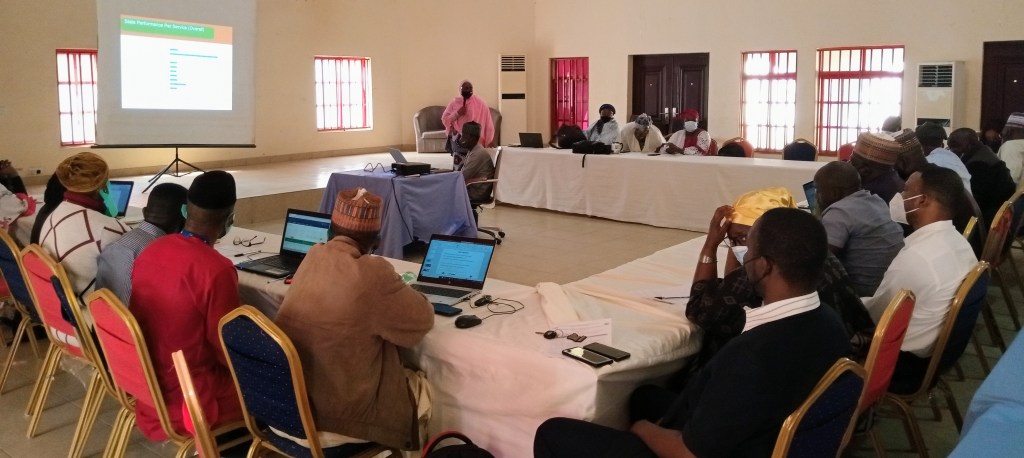
The stakeholders, working in health and nutrition sector gave the commendation in Kaduna, at a one-day Quarterly Stakeholders Debriefing Meeting on ANRiN project.
According to them, the project is yielding the desired result.
The Director Public Health, Ministry of Health, Dr Hajara Kera, said that the project with counterpart fund from the state government was reaching out to people with nutrition and reproductive services in communities and health facilities.
Kere said that the project was in line with Kaduna state government efforts toward prevention of malnutrition in communities through provision of high-quality cost-effective services and counseling.
She commended ANRiN and its Non-State Actors (NSA) for reaching out to a huge number of people across the 23 local government areas of the state in 2021.
She equally thanked development partners and relevant stakeholders supporting the state to address the scourge of malnutrition in the state.
Dr Idris Baba, the Officer-in-Charge, UNICEF Kaduna Office, described the efforts as “commendable”, considering the indices of malnutrition in the state.
Baba said that the house-to-house and facility-based delivery of nutrition and reproductive health services were effective strategies in providing quality services to target groups.
UNICEF Nutrition Specialist, Mrs Chinwe Ezeife, also lauded efforts toward preventing malnutrition in communities through the provision of critical nutrition services at community level.
Ezeife, particularly commended NSA for referring malnourished children to facilities for medical attention but expressed concern about the non-availability of Ready-to-Use Therapeutic Foods.
She appealed to ANRiN and the Kaduna state government to allocate resources for the procurement of RUTF and other commodities needed to prevent avoidable deaths from malnutrition.
Also, Mrs Sarah Kwasu, the State Team Lead Alive and Thrive (FHI 360), equally congratulated ANRiN for the impressive achievements so far, describing it as a great opportunity for other partners to learn.
Similarly, Mr Umar Bambale, the Project Manager, Kaduna State Emergency Nutrition Action Plan, pointed out that the ANRiN project was addressing service delivery gaps in communities and health facilities.
Bambale expressed confidence that if sustained, the project would help kick malnutrition out of Kaduna state in no distant time.
Earlier, ANRiN Project Coordinator in the state, Dr Zainab Muhammad-Idris, said ANRiN was a five-year project designed to increase utilisation of quality, cost-effective nutrition services for pregnant and lactating women, adolescent girls, and children under five years in the state.
According to her, the objective is to reduce chronic malnutrition, maternal and child mortality rates and in the long run, increase school completion, performance, and improve labour force productivity.
“So far, the project reached a total of 895,724 in 2021 through eHealth and Society for Family Health, the two NSA contracted to deliver the services to the target groups at community level.
“While SFH reached 458,502 target groups between August and December, eHealth reached a total of 437,222, between October and December, amounting to a total of 895,724 people.”
The coordinator identified some of the services as deworming for children aged 12 to 59 months, iron-folic acid to pregnant women, intermittent preventive treatment for malaria to pregnant women, and micronutrient powder for children six to 23 months.
Others are Maternal, Infant and Young Child Nutrition counseling for pregnant and lactating women, Vitamin A supplementation for children six to 59 months, and Zinc/ORS for children between six and 59 months for diarrhea.
She said that the objective was to review the performance of Non-State Actor from inception to date, achievements, challenges, lessons learnt, best practices and present NSAs two-year work Plan.
The State Nutrition Officer, Mrs Ramatu Haruna, said that the project had scaled up nutrition and reproductive health services at facility level from 16 facilities in four LGAs to 100 facilities in 12 LGAs. (NAN)
 Development Diary
We the health providers appreciate the management of ehealth for giving us this privilege for the project that we are doing, with the management efforts malnutrition will eradicated in Kaduna state.
LikeLike
Police say that pls my love and miss busy with me oooo
LikeLike