By Philip Yatai
The Federal Ministry of Youths and Sports Development has begun sensitisation of stakeholders on the Nigerian National Action Plan on Youth, Peace, and Security (NNAP-YPS), 2021 to 2024 for implementation in Kaduna State.
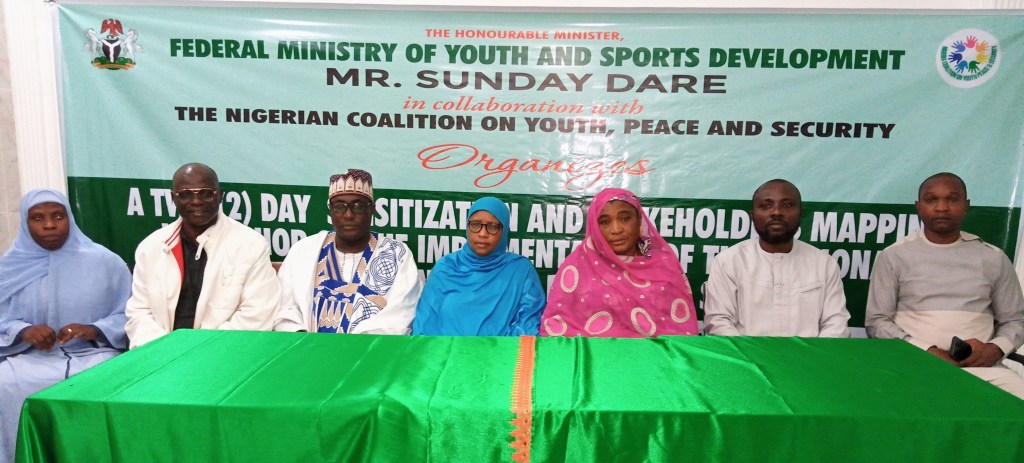
The Minister, Mr Sunday Dare stated this in Kaduna on Tuesday, at the opening of a two-day sensitisation and stakeholders mapping on the NNAP-YPS in collaboration with the Nigerian Coalition on Youth, Peace, and Security.
Dare, who was represented by Mrs Amina Dauran, Director, Network and Social Mobilisation in the ministry, said that the NNAP-YPS would be implemented in five pilot states and the Federal Capital Territory, Abuja.
He identified the five states as Adamawa, Delta, Kaduna, Oyo, and Plateau states to measure impact and collect data that will guide scaling full implementation to other states.
“We are here today to create awareness on the NNAP-YPS document and to map the stakeholders that we need to engage to implement the NNAP-YPS in Kaduna state.
“We are hopeful that the implementation of the NNAP-YPS will open positive and sustainable opportunities for young people including the space to express their talents and contribute to lasting peace and development.
“I call on the Kaduna State Government, civil society organisations and youth groups, community, traditional and religious leaders, security agencies and the media to support the implementation.
“This bold step would give opportunities to the youth to express their talents and creativities leading to lasting peace and development of Kaduna State and our nation,” he said.
The minister explained that the NNAP-YPS was officially launched in Nov. 2021 in line with the United Nations Security Council Resolution (UNSCR) 2250 on Youth Peace and Security.
According to him, the move is a renewed focus that brings attention to the issues of youth, peace, and security agenda in Nigeria.
The Co-chair, Nigerian Coalition on Youth, Peace, and Security, Mr Theophilus Ekpon, said that programmes have been mapped out for implementation of the action plan in Kaduna state.
Ekpon identified some of the programmes to include psychosocial support for drug addicts and rehabilitation and reintegration of survivors of gender-based violence.
He also said that funds would be made available to enable the youths implement their projects and programmes to keep them engaged.
“The youths will tell us what they want to do, and we will provide the needed technical and financial support, especially those at community level.
“This will prevent them from being recruited into bandit and terrorist groups.
“We will also engage the private sector to ensure that they do no harm to the youth and bring out resources for the development and empowerment of young people,” he said.
Hajiya Hafsat Baba, Commissioner, Kaduna State Ministry for Human Services and Social Development, thanked the federal government for selecting the state as one of the pilot states.
Baba, who was represented by Hajiya Maryam Muazu, Director, Youth Development, said that the state government would mobilise the youths to maximise the benefits of the action plan.
Mr Bagudu Nathaniel, Chairman, National Youth Council of Nigeria, Kaduna State Chapter, expressed excitement over the steps taken to implement the NNAP-YPS in the state.
According to Nathaniel, the plan, if implemented, will ease the stress of young people, particularly on issues around insecurity, peacebuilding, and youth empowerment in urban and rural communities.
He added that the action plan would address the exclusion of the youths in decision-making and the governance process.
He explained that most of the youths’ programmes and plans were being developed and implemented without inputs from the youths, thereby creating a gap between young people and the government.
The NNAP-YPS demonstrates Nigeria’s commitment as well as accountability in ensuring the meaningful participation of youth in conflict prevention, post-conflict, and peacebuilding efforts.
It is a practical and operational tool for youths to be involved in government and stakeholders’ response to their concerns as well as the assistance programmes available to them.
The action plan also ensures the safety and security of youths from extrajudicial killings and unlawful detention as well as identifying their specific needs in terms of disarmament, de-radicalisation, and rehabilitation.
 Development Diary