By Philip Yatai
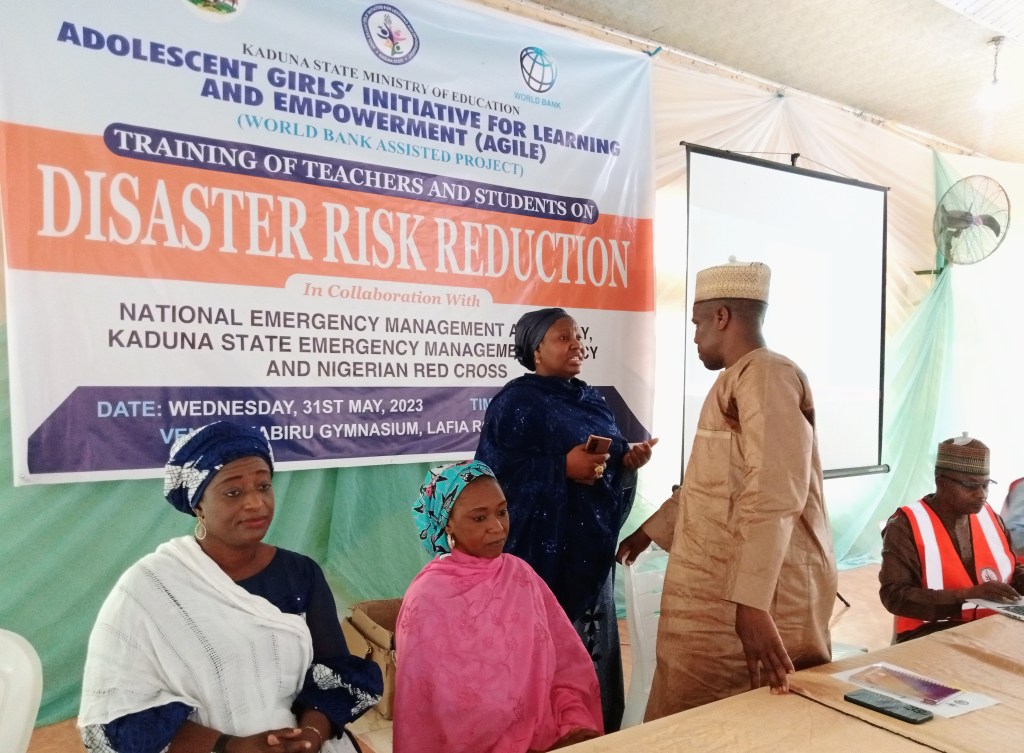
The Kaduna State World Bank-supported Adolescent Girls Initiative for Learning and Empowerment (AGILE) project has trained secondary school teachers and students on disaster risk reduction.
The Project Coordinator, Hajiya Maryam Dangaji said in Kaduna on Wednesday, that the training was under the AGILE project’s Environmental and Social Safeguard.
The News Agency of Nigeria (NAN) reports that the training was organised in collaboration with the National Emergency Management Agency (NEMA), Kaduna State Emergency Management Agency (SEMA), and the Nigerian Red Cross.
Dangaji said the training was necessary due to unforeseen disasters and hazards that could affect schools.
According to her, educating teachers and students on early warning signals and ways to mitigate them is critical to maintaining a safe learning environment.
“Disaster risk reduction is not a government job alone.
“We all have a role to play and as such, we want the teachers and their students to know the potential disasters and risk, and the simple steps to take within the school environment to reduce or avert them.
“Knowing what they need to do during an emergency or disaster, will ensure a conducive teaching and learning environment and this a key priority for the AGILE project.”
In his remarks, Mr Imam Garki, Zonal Coordinator, NEMA, commended AGILE for organising the training, describing it as “apt” in view of the spate of disasters in communities.
Garki equally said that disaster management was everybody’s responsibility, noting that the government cannot do it alone.
The training, he said, would enable students and young children to understand that they have a very important role to play as Nigerians in managing disasters in the country.
He said disaster is everywhere, adding that every community experience one form of disaster or the other.
“For example, there is disease outbreak in communities due to lack of cleanliness and as such, educating the children to keep their environment clean will help reduce some disease outbreaks.
“There is also the issue of flooding that is an annual ritual that happens every year affecting schools, students, teachers and other people in communities and enlightening people on what to do is very important.
“We equally have recurrent building collapses in some parts of the country and fire outbreaks among others. Giving ideas on how to make themselves safe is very important.
“In all, catching them at this young age is very important and I believe that the knowledge that will be impacted on them will make a significant impact in their lives,” the zonal coordinator said.
On her part, AGILE’s Environmental Safeguard Officer, Maureen Oyedoja said that principals and students across 20 senior and junior secondary schools participated in the training.
NAN reports that the AGILE project is the initiative of the Federal Government with funding support from the World Bank.
The project aimed to ensure adolescent girls access quality secondary education, through enhanced learning, digital literacy and life skills which empowered and assured better life chances and experience. (NAN)
 Development Diary